
















In This Article:
- The Mechanics of Metrology-Grade Mobile Dispensing
- Resolving the Portable Power Challenge
- Equipment Selection Guide: Matching Flow to Fleet
- Critical Indian Industrial Contexts for Bowsers
- Calibration, Legal Metrology, and Maintenance
- Frequently Asked Questions
- The Engineer’s Verdict
- Ready to Deploy a Mobile Bowser?
Engineering Guide to Mobile Fuel Dispensers: Securing Off-Grid Diesel Transfers
An uncalibrated, gravity-fed bowser dispensing 5,000 liters of High-Speed Diesel (HSD) daily with a standard 1.5% mechanical drift costs your project Rs 24.6 lakh in unrecorded fuel every year. That is not a rounding error; that is a major operational leak.
In my 22 years as a Flow Measurement Engineer at Chintan Engineers, I have inspected hundreds of mobile fueling setups—from remote mining pits in Odisha to highway expansion projects in rural Gujarat. Most fleet operators weld a rudimentary centrifugal pump to a mild steel tank, slap on a cheap water meter, and call it a mobile dispenser. (I’ve calibrated enough of these jury-rigged systems to know they don’t belong anywhere near high-value hydrocarbons—and frankly, it’s a miracle some of them haven’t caused a catastrophic failure.)
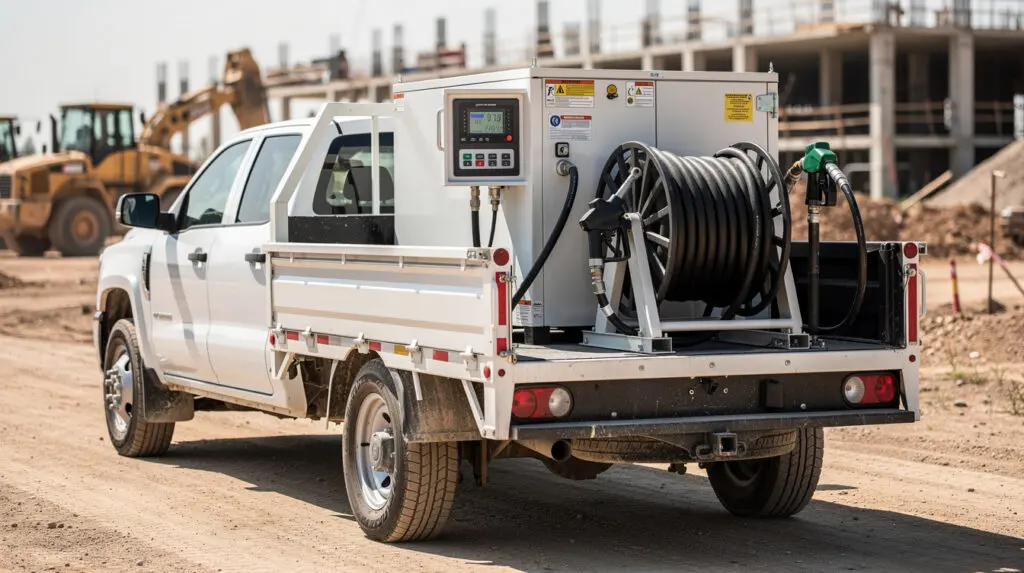
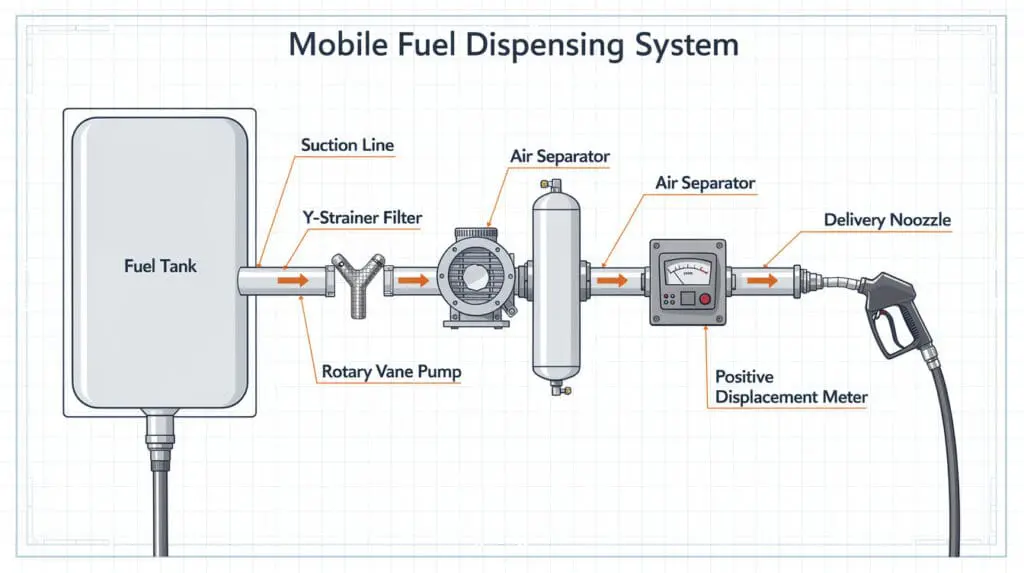
True mobile dispensing requires a self-contained skid engineered for the brutal realities of field operations. You need rotary vane suction, positive displacement (PD) metering, and digital batch controllers capable of handling alternator voltage spikes.
If you are evaluating mobile fueling skids for your fleet, I’ve laid out the exact specifications, Legal Metrology compliance requirements, and mechanical parameters you must demand from your equipment.
The Mechanics of Metrology-Grade Mobile Dispensing
Mobile dispensing isn’t just a miniaturized depot. It introduces specific hydraulic challenges completely absent in static environments. Fluid sloshing, air entrainment, and DC power limitations fundamentally alter how fuel measurement must be approached.
1. Suction and Pumping Mechanics
Gravity-fed systems fail because flow rates fluctuate directly with tank head pressure, destroying meter linearity. (Try calibrating a meter when your pressure drops by half every three hours. You can’t.) A proper mobile fuel dispenser utilizes a DC-powered continuous-duty rotary vane pump with an integrated bypass valve.
When an operator shuts off the nozzle, the pump must internally recirculate the diesel. If your skid lacks a calibrated bypass valve (set typically at 0.3 MPA or 3 BAR, as we integrate into our CE-206 and CE-117 units), deadheading the pump will rupture your hose lines within weeks.
2. Air Elimination
Mobile tanks agitate fuel. Think about a truck bouncing over unpaved access roads. If you push air-entrained diesel through a flow meter, you are charging your fleet ledger for empty space. Commercial bowsers must incorporate air separation units before the metering chamber to comply with OIML R117 guidelines for dynamic measuring systems.
3. Positive Displacement Metering
Never accept a turbine meter on a mobile diesel bowser. I mean it. Viscosity changes due to ambient temperature shifts (like a 15°C morning in Rajasthan vs a 45°C afternoon) will skew a turbine rotor’s K-factor. Mobile systems mandate Positive Displacement (PD) meters—specifically oval gear or oscillating piston mechanisms—which isolate precise volumetric parcels of fluid regardless of line pressure or viscosity.
Resolving the Portable Power Challenge
One of the most frequent failure points I see in GIDC industrial estates and remote sites is electrical burnout.
Vehicle alternators do not provide clean power. A standard 12V or 24V DC truck battery circuit will experience severe voltage dips during engine start and spikes during high-RPM operation. If the dispenser’s digital controller lacks voltage regulation, your calibration factors will corrupt, or worse, the CPU will fail. (I’ve seen controllers fry on day two of deployment for exactly this reason.)
That’s why our CE-204 and CE-206 builds use isolated power regulators that accept dirty 12/24V DC input and provide stable logic voltage to the preset controller. For heavy-duty rigs relying on portable DG sets, we specify 220V AC motors with thermal overload protection.
Equipment Selection Guide: Matching Flow to Fleet
Looking for the right Mobile Fuel Dispenser? Our engineers can help you select the perfect configuration for your application. View Mobile Fuel Dispenser specifications or request a quote.
Procurement decisions must be based on flow rate requirements and audit trail necessities. Oversizing a dispenser leads to excessive power draw; undersizing it costs you massive operational downtime. How many minutes can your dump trucks afford to idle while waiting for fuel? Here is the field data you need for specification sizing.
Digital Preset & Audit Models
For operations requiring strict accountability and digital receipting, you need microprocessor-based units.
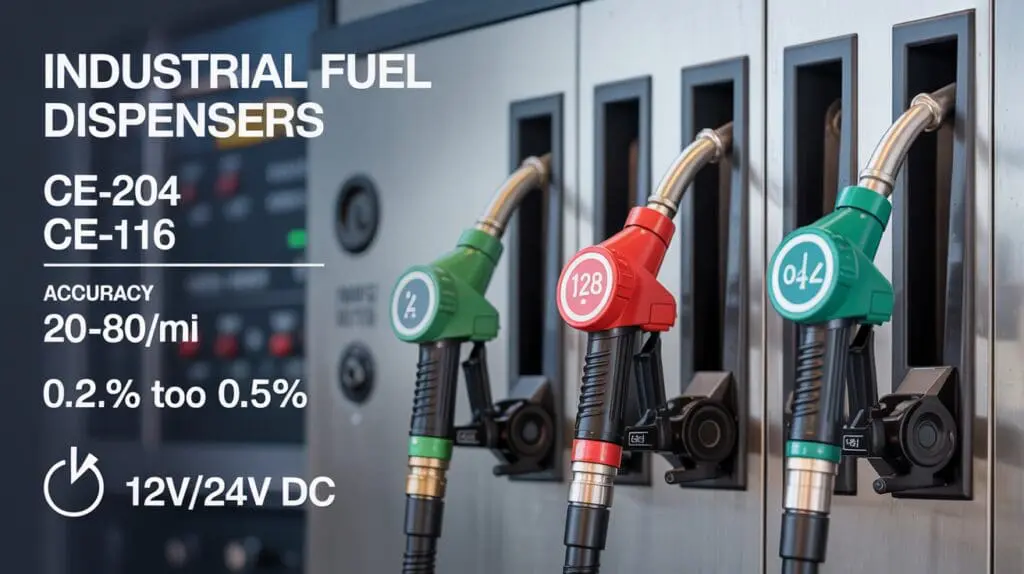
- CE-204 High Accuracy Mobile Dispenser: This is our flagship for stringent transaction tracking. It pushes 20–80 L/min with an exceptional accuracy of ±0.2%. More importantly, it features a 365-day internal transaction log and is printer-ready. If you are fueling multiple sub-contractor vehicles and need to cross-charge them, this is realistically your only reliable option.
- CE-206 Digital Dispenser: Engineered for heavy fleet fueling and agricultural depots. It delivers 20–80 L/min at 0.5% accuracy. Operating at a maximum pressure of 0.3 MPA on DC12V/24V, it retains daily data for the last 365 days and monthly data for 12 months. You will appreciate this audit trail when reconciling monthly fuel purchases against field consumption.
- CE-117 Digital Dispenser: A ruggedized, brass-component system ideal for standard fleet maintenance rigs. It operates between 40–60 L/min at 0.5% accuracy with a maximum pressure of 3 BAR. It ships with a 4m rubber hose and an ambient noise automatic shutoff nozzle—which is an absolute lifesaver to prevent overspills during night operations.
Mechanical Utility Models
- CE-101 Mechanical Dispenser: Sometimes, you just need a heavy-duty, un-killable mechanical register. Pushing 40–60 L/min with 0.5% accuracy, this unit requires zero logic power. We deploy these heavily in deep-cast mining operations where airborne conductive dust makes digital displays a nightmare.
If you want the full math on meter selection, review my breakdown in the Fuel Flow Meter Specifications: Engineer Guide.
Critical Indian Industrial Contexts for Bowsers
Designing for European highways is easy. Designing for Indian off-road infrastructure projects requires a different engineering philosophy entirely.
1. Monsoon Ingress Protection
A mobile skid mounted on a pickup bed is fully exposed to driving monsoon rains. (Water and digital controllers don’t mix, obviously.) The electronic enclosures on our CE-series digital dispensers utilize IP65 minimum rated seals. Furthermore, mechanical counters (like the CE-101) feature anti-fogging glass to prevent condensation from obscuring the totalizer.
2. Dust and Filtration
If you operate near cement plants or iron ore mines, airborne particulate will bypass substandard tank breathers. When that silica dust reaches your dispenser pump, it acts as a grinding paste on the rotary vanes. We mandate 10-micron inline filtration upstream of the pump, not just for engine protection, but to preserve the flow meter’s metrological accuracy.
3. Hazardous Area Classification
If your bowser operates inside a refinery fence line or a chemical processing zone, standard DC motors are a catastrophic liability. For these environments, we engineer skids utilizing EX/FLP (Flameproof) motors certified to IS 2148 standards, complete with static grounding reels.
Calibration, Legal Metrology, and Maintenance
Installing a highly accurate dispenser is only step one. Maintaining that accuracy dictates your true ROI.
Volume Proving in the Field
Per Legal Metrology Act guidelines and BIS standard IS 14883, fuel dispensing units must be periodically calibrated. For mobile bowsers, this is notoriously difficult. Have you ever tried tracking down a mobile bowser to bring it back to a static proving station? It’s a logistical headache.
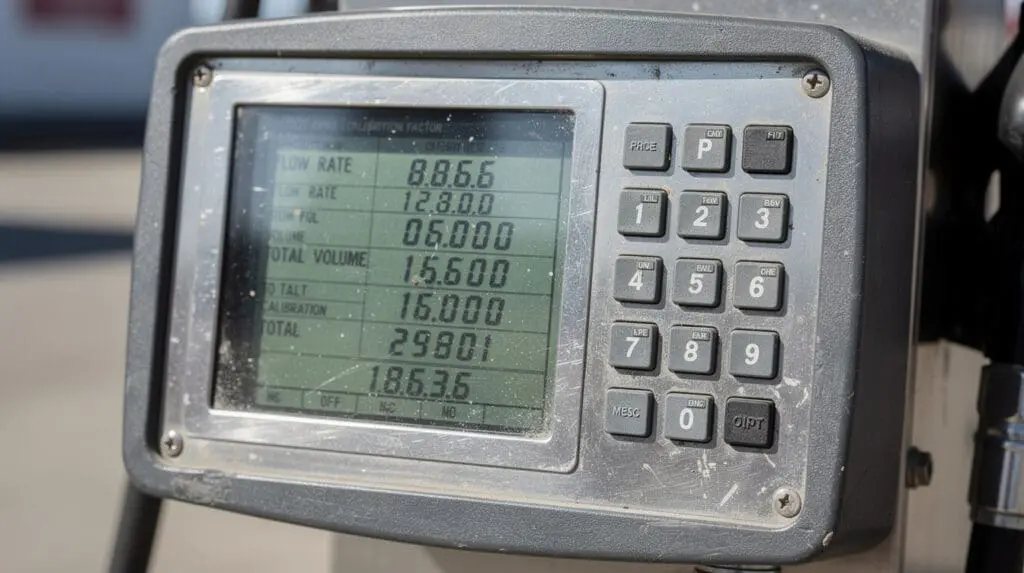
We recommend fleet managers utilize certified 20-liter or 50-liter proving measures. The calibration process involves dispensing exactly 20 liters into the prover. If the meter reads 20.10 liters, you have a +0.5% error. Modern digital heads like the CE-204 allow for software-level electronic calibration (adjusting the pulse-per-liter K-factor) directly via the keypad, rather than relying on mechanical gear changes—which nobody enjoys doing in the field.
For the exact procedural requirements on maintaining calibration certificates, refer to my Mobile Fuel Dispenser Specs & Calibration documentation.
Preventative Maintenance Schedule
- Weekly: Inspect the auto-shutoff nozzle spout for damage. A bent sensor tube will prevent the vacuum shutoff from triggering, causing a spill.
- Monthly: Check the inline Y-strainer or spin-on filter. A clogged filter will cause the pump to cavitate, drastically reducing your 80 L/min flow rate down to a trickle.
- Bi-Annually: Inspect the DC power cables connecting the skid to the vehicle battery. Abrasion from truck vibration is the leading cause of electrical shorts in mobile skids.
Frequently Asked Questions
Looking for the right Mobile Fuel Dispenser? Our engineers can help you select the perfect configuration for your application. View Mobile Fuel Dispenser specifications or request a quote.
Can I run the dispenser entirely on vehicle battery power?
Yes. Our DC12V and DC24V motors are engineered precisely for this. They power the rotary pump, the metering unit, and the controller. We recommend wiring directly to the battery terminals with an inline fuse rather than using accessory ports.
How does the dispenser handle voltage fluctuations from alternator output?
Our digital models (CE-204, CE-206) feature onboard power regulation that stabilizes fluctuating DC input, protecting the CPU and ensuring that calibration data isn’t corrupted during engine RPM surges.
What is the process to prevent pilferage during remote dispensing?
Pilferage is a reality in remote sites, but it’s eliminated through access control and audit trails. The CE-204 and CE-206 feature preset controllers with password locks. More importantly, they store a 365-day internal log of every transaction, which can be printed via an optional receipt printer for immediate reconciliation.
Do you offer flameproof (FLP) configurations?
Yes. If your bowser enters hazardous zones, you must specify an EX/FLP motor and flameproof enclosure. Standard DC brush motors generate sparks; FLP variants are mandatory for site compliance.
How often should mobile bowsers be calibrated?
Due to the vibration of mobile mounting, we recommend verifying calibration every 3 to 6 months using a certified 20-liter standard measure, adjusting the electronic K-factor as necessary to maintain ±0.5% accuracy.
Is hose management included in standard skids?
Standard kits like the CE-117 come with a 4m rubber delivery hose. For heavy-duty builds, we strongly recommend integrating a spring-rewind hose reel (capable of holding up to 15m of hose) to prevent vehicles from running over uncoiled lines.
The Engineer’s Verdict
Building a mobile fuel bowser is not about moving liquid from point A to point B. It is about extending your depot’s financial and metrological control out into the field.
Based on over two decades of analyzing field failures and calibration drifts, my recommendation is unequivocal: Do not compromise on the metering technology. If your operation demands absolute accountability and sub-contractor billing, specify the CE-204 Digital Preset Dispenser. The ±0.2% accuracy and 365-day transaction log will pay for the skid in prevented fuel losses within the first quarter of deployment.
If you are running a rugged, high-dust operation where digital screens are a liability, deploy the CE-101 Mechanical Dispenser.
Ready to Deploy a Mobile Bowser?
Stop losing diesel to mechanical drift and unrecorded manual logs. Contact Chintan Engineers with your tank capacity, power availability (12V/24V/220V), and desired flow rate. We will engineer a metrology-grade mobile dispensing skid tailored exactly to your fleet’s operational reality.
META: Title=Mobile Fuel Dispenser Engineering Guide | Desc=An engineer’s guide to mobile fuel dispensers and bowsers. Technical specs for CE-204 and CE-206 DC/AC pumps, accuracy rates, and field calibration. | Slug=mobile-fuel-dispenser-engineering-specifications | Keyword=Mobile Fuel Dispenser
IMAGE PLAN (pass through unchanged):
[{“slot”:1,”position”:”After the intro, setting the scene”,”prompt”:”Photorealistic, high-resolution image of a heavy-duty mobile fuel dispenser skid mounted on the bed of a white industrial pickup truck. The truck is parked on a dusty, active construction site. The dispenser features a bright digital display, a coiled black fuel hose on a reel, and an automatic nozzle. Clear, sharp engineering aesthetic. Natural daylight.”,”alt_text”:”Mobile fuel dispenser skid mounted on a pickup truck bed at an industrial site”,”model_suggestion”:”flux-2-pro”},{“slot”:2,”position”:”Under ‘The Mechanics of True Mobile Dispensing’ section”,”prompt”:”Technical schematic diagram of a mobile fuel dispensing system. The SVG-style diagram should clearly label the components: Fuel Tank, Suction Line, Y-Strainer Filter, Rotary Vane Pump, Air Separator, Positive Displacement Meter, and Delivery Nozzle. Use clean industrial colors, sharp lines, and engineering blueprint style.”,”alt_text”:”Schematic diagram of mobile fuel dispenser components including rotary pump and positive displacement meter”,”model_suggestion”:”recraft-v4-svg”},{“slot”:3,”position”:”Under ‘Equipment Selection Guide’ section”,”prompt”:”A clean, modern data infographic comparing industrial fuel dispensers. Text overlay should include ‘CE-204’, ‘CE-206’, and ‘CE-117’. Visual elements should represent flow rates (20-80 L/MIN), accuracy (0.2% to 0.5%), and power icons (12V/24V DC). Professional B2B engineering color palette with high contrast.”,”alt_text”:”Comparison infographic of CE-204, CE-206, and CE-117 mobile fuel dispenser specifications”,”model_suggestion”:”ideogram-v3″},{“slot”:4,”position”:”Under ‘Volume Proving in the Field’ section”,”prompt”:”Photorealistic extreme close-up of an industrial digital fuel meter display and keypad on a dispenser head. The screen shows a digital readout with precise numbers, suggesting a data log or calibration factor. The device looks robust, built from metal and heavy-duty plastic, under harsh outdoor sunlight, emphasizing its rugged IP65-rated nature.”,”alt_text”:”Close up of a digital preset fuel controller screen showing calibration data in sunlight”,”model_suggestion”:”flux-2-pro”}]
Products Mentioned in This Article:
- Mobile Fuel Dispenser — View full specifications and request a quote
Need Help Choosing the Right Mobile Fuel Dispenser?
Our engineering team has configured over 5,000 systems across India. Tell us your application, flow rate, and medium — we will recommend the right solution.
Get Expert Recommendation | View Mobile Fuel Dispenser Specs