A 0.5% calibration drift on a 10,000-litre/day lubricant or chemical packaging line costs your operation exactly ₹18.25 lakhs per year in untracked product giveaway.
When procurement managers call my desk at Chintan Engineers asking for the absolute lowest liquid batching system price, I point directly to that number. Over my 22 years of designing and calibrating over 5,000 flow measurement systems across India, I have watched countless boards approve a low-capex skid, only to bleed capital through daily volumetric overshoot, premature valve failure, and relentless maintenance downtime.
You are not buying a pump and a meter. You are buying volumetric certainty.
Let me break down the true industrial batching system cost over a 5-year lifecycle. We need to look beyond that initial quotation—which is almost always deceptive—and examine the real operational expenses (OPEX). Specifically, we are going to look at calibration frequency, pneumatic valve wear, and the catastrophic ROI impact of product giveaway in high-volume Indian process plants.
₹91.25 Lakhs The cumulative 5-year cost of product giveaway on a standard 10,000 L/day line operating with a cheap, uncompensated meter drifting by just 0.5%.
CAPEX vs. OPEX: Deconstructing the Total Cost of Ownership

When evaluating an automatic batching system India tender, the capital expenditure (CAPEX) usually accounts for merely 15% to 20% of the Total Cost of Ownership (TCO) over a standard five-year operational lifecycle.
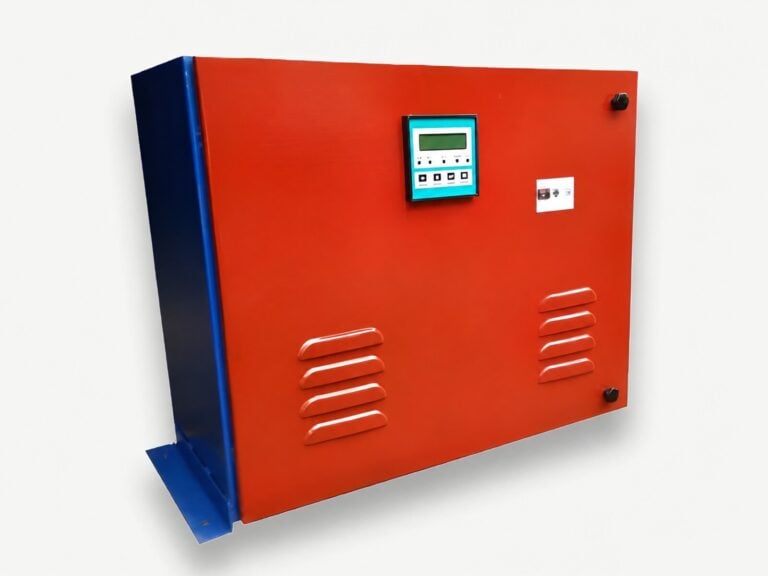
The initial skid price includes the positive displacement (PD) or turbine meters, the preset controller (like our CE-136), the PLC/HMI, actuated valves, and the pump block. A budget system might look attractive on a spreadsheet, saving your procurement team ₹1.5 to ₹2 lakhs upfront. But here is the engineering reality: that saving is immediately absorbed by the OPEX in year one.
The operational expenses of a liquid batching system are governed by three immovable factors:
- Volumetric Giveaway: The cost of dispensing 100.5 litres into a 100-litre drum simply because the single-stage valve cannot close fast enough to prevent overshoot.
- Calibration Drift & Intervention: The labor, downtime, and master-meter certification costs required to bring drifting sensors back into Legal Metrology Act compliance.
- Actuation Wear: The mechanical replacement cycle of standard solenoid valves versus heavy-duty pneumatically actuated ball valves.
The field data tells a brutal story.
The High Cost of Product Giveaway (Accuracy vs. Drift)

I have calibrated enough cheap turbine meters to know they do not belong anywhere near viscous fuels or lubricants—and it drives me crazy when I see them specified for these applications. Turbine rotors rely on the kinetic energy of the fluid. When viscosity shifts due to ambient temperature changes (a daily occurrence in Indian sheds without climate control), the slip factor changes, and the meter's K-factor drifts entirely off the curve.
If you are batching diesel, lubricants up to 5,000 mPa·s, or specialty chemicals, you require a system built strictly on Positive Displacement (PD) principles. Our skids utilize CE-110/111 PD meters or CE-210 helical sensors that isolate specific fluid volumes mechanically. The accuracy becomes independent of viscosity.
On a high-capacity skid, we achieve ±0.5% accuracy as a baseline, and we tighten that to ±0.2% on our CE-113-based custody transfer skids.
5-Year Giveaway ROI Calculation
Assume a lube oil plant filling 500 drums (200L each) daily. That is 100,000 litres per day. The fluid value is roughly ₹150/litre.
| Metric | Budget Turbine Skid (±1.0% actual drift) | Chintan CE-136 PD Skid (±0.2% controlled) |
| :— | :— | :— |
| Daily Volume | 100,000 L | 100,000 L |
| Daily Overshoot | 1,000 L | 200 L |
| Daily Value Lost | ₹1,50,000 | ₹30,000 |
| Annual Loss (300 days) | ₹4.5 Crores | ₹90 Lakhs |
| 5-Year Giveaway Cost | ₹22.5 Crores | ₹4.5 Crores |
A precision liquid dosing system price might be 30% higher upfront, but the ₹18 Crore variance in 5-year product retention makes the initial CAPEX debate entirely irrelevant. Stop arguing over pennies when you are losing thousands of litres.
If your process involves custody transfer or billing based on the batched volume, your system must comply with OIML R117 guidelines and BIS standard IS 14883. Do not accept a vendor's "factory calibration" certificate without asking for the repeatability percentage over 10 consecutive batch runs.
Losing product to inaccurate batching?
Stop the giveaway. Let our engineers design a high-accuracy, dual-stage batching skid tailored to your fluid's exact viscosity and flow profile.
Valve Dynamics: Preventing Overshoot with Dual-Stage Control

The most frequent point of failure I see in budget batching setups across GIDC industrial estates is the valve architecture. Many vendors use single-stage electrical solenoid valves to cut costs.
I always tell plant managers: here is the mechanical reality. If you are pumping 120 L/min into a tote, and the preset controller hits the target volume, a single-stage valve takes approximately 0.4 to 0.8 seconds to close mechanically against the line pressure. In that half-second, an extra 1 to 2 litres of fluid bypasses the meter. You just gave away product for free.
To combat this, Chintan liquid batching systems employ dual-stage pneumatic valve control paired with PLC logic or our CE-Setstop preset counter.
- Fast Fill Mode: Both valve stages open. The rotary vane or gear pump drives the fluid at maximum flow (e.g., 120 L/min).
- Trim Mode (Slow Fill): At 95% of the target batch, the primary valve closes. Flow restricts to a precise trickle (e.g., 15 L/min).
- Dead Stop: At exactly 100.0%, the secondary valve snaps shut in milliseconds.
This multi-stage batching logic entirely eliminates hydraulic hammer and reduces volumetric overshoot to practically zero. On top of that, air-actuated pneumatic valves handle high-cycle fatigue significantly better than standard electrical solenoids, pushing the maintenance replacement cycle from 12 months out to 48+ months.
Selection Guide: Matching the Skid to the Process

If there's one thing two decades in this industry has taught me, it's that no single skid fits all processes. Below is a breakdown of specific configurations we deploy based on operational demands. For a deeper dive into fuel specifically, review our Buyer's Guide: Choosing the Right Fuel Flow Meter.
1. CE-136 Preset Batching System (Chemicals & Process Vessels)
Designed for dispensing exact quantities into batch reactor vessels or storage tanks.
- Accuracy: ±0.5%
- Control: Electrically activated on/off valves (upgradable to pneumatic for high viscosity).
- Features: Preset quantity dispensing, automatic cutoff, heavy-duty relay outputs.
- Ideal For: Plant environments where operators need to punch in "500 Liters," hit start, and walk away.
2. CE-215 Custom Liquid Dispenser (Multi-Fluid & Tote Filling)
Built for dynamic environments needing a standalone unit with a highly visible HMI.
- Display: Digital Backlit LCD with accurate flow calculator board.
- Power: Flexible DC and AC Power Supply (highly resistant to voltage sags).
- Customization: Fully customizable flow rate manifolds for almost all liquids.
- Ideal For: Drum filling stations and custom chemical transfer operations. If you are handling aggressive chemicals, ensure you pair this with the right pump material, as outlined in our PP Pump Specifications Guide.
3. CE-206 Digital Dispenser (Fuel & Fleet Depots)
When batching diesel into fleet vehicles or genset reservoirs, data tracking is as important as accuracy.
- Specs: 20-80 L/min flow range, max pressure 0.3 MPa, ±0.5% accuracy.
- Data Logging: Storage of daily data for 365 days, and monthly data for the last 12 months.
- Outputs: Receipt printer available on demand.
- Ideal For: Factory fuel management, agricultural fueling, and oil depot loading.
Never specify a batching meter based solely on line size (e.g., "I need a 2-inch meter"). You must size the skid based on the minimum and maximum flow rates and the specific gravity of the fluid. An oversized meter running at 10% capacity will slip fluid and silently destroy your batch accuracy.
Indian Industrial Context: Surviving Aggressive Environments

We build systems in Ahmedabad and deploy them from coastal refineries in Jamnagar to pharmaceutical hubs in Baddi. Over the years, I have learned that a batching system's survival depends on how it handles three distinctly Indian industrial challenges (and trust me, standard European imports often fail here):
- Severe Voltage Fluctuations: Industrial grids in remote estates frequently drop from 220V to 160V. Standard controllers reset mid-batch, causing operator confusion and—inevitably—double-dosing. We utilize wide-band SMPS (Switched-Mode Power Supplies) and battery-backed memory on our CE-136 and CE-206 models. If power fails, the exact batched volume is saved. When power returns, the batch resumes precisely where it left off.
- Monsoon Humidity & Pneumatics: Coastal humidity wreaks havoc on compressed air lines, injecting water into pneumatic valve actuators. Our turnkey skids include dedicated air filter regulators (FRL units) and inline strainers to protect the actuation system.
- Hazardous Area Compliance: For petrochemical sites or when batching highly volatile solvents, we upgrade the architecture to include flameproof (FLP) motors, intrinsically safe (IS) barriers for the meter pulses, and stainless steel manifolds. (For pharma applications requiring absolute sanitation, we integrate specialized SS Pumps for Pharma Manufacturing).
Under the Legal Metrology Act in India, any flow meter used for commercial transaction (buying/selling) must be stamped and verified annually by the state Weights and Measures department. High-quality PD meters retain their calibration curve significantly better, saving you the nightmare of mid-year emergency recalibrations.
Need a batching system built for tough Indian environments?
Our skids come pre-wired, pre-piped, and factory-tested with integrated filtration and flameproof options. Drop it into your line and start batching accurately on day one.
Installation & Long-Term Maintenance Rules
I've seen state-of-the-art ₹15 lakh systems destroyed in a week because of bad piping. When we conduct a Factory Acceptance Test (FAT) at Chintan Engineers, we simulate your exact batch volumes to tune the fast/slow valve timing. But once it leaves our facility, onsite reality kicks in. You must enforce these rules:
- Upstream Filtration: PD meters have extremely tight internal clearances (often a few microns). A single piece of welding slag from newly fabricated plant piping will seize the rotors instantly. Always install the provided Y-strainer or basket strainer immediately upstream of the pump/meter skid.
- Air Elimination: If your supply tank runs low, the pump will pull air. Air spins the flow meter just like liquid, leading to massive over-registration (the meter reads 100L, but you only pumped 80L of liquid and 20L of air). Every high-accuracy skid we build includes a mechanical air eliminator vessel before the measuring chamber.
- Calibration Schedule: Mandate a volumetric proving test every 6 months using a certified master measure. Do not wait for operators to complain about overflow to realize the meter has drifted.
Frequently Asked Questions
What is the typical flow capacity of an automatic batching system?
Our standard turnkey skids handle 5 to 120 L/min per stream. However, for bulk depot loading or large reactor filling, we engineer custom high-capacity manifolds capable of pushing 500 to 1,000 L/min utilizing larger CE-111 PD meters and high-flow dual-stage valves.
Can the batching system integrate with our plant's SCADA or ERP?
Yes. The preset controllers and PLCs feature pulse, 4–20 mA, and RS485 (Modbus RTU) outputs. This allows every single batch volume, timestamp, and fault code to be logged directly into your MES or ERP dashboard, ensuring total digital traceability without manual ticket entry.
How does the system prevent overshoot on small batches (e.g., 5 Litres)?
For small batches, managing overshoot is critical. We utilize highly responsive CE-136 preset controllers paired with rapid-acting solenoid or pneumatic valves. By adjusting the "trim mode" offset in the software, the controller commands the valve to close a fraction of a second before hitting the 5-litre mark, allowing the fluid's kinetic momentum to push the final exact milliliters through the meter without spilling over.
What maintenance is required for the positive displacement meters?
PD meters are incredibly robust but require clean fluid. Maintenance primarily involves cleaning the upstream strainers weekly. Annually, the measurement chamber should be inspected for rotor wear, and the mechanical seals on the pumping unit should be checked.
Does Chintan Engineers provide the pumps with the batching skid?
Yes, and I highly recommend procuring it this way. A batching system is a unified hydraulic circuit. We supply matched rotary vane, gear, or centrifugal pumps as part of the complete skid, fully piped with the necessary bypass valves and static grounding. This ensures minimal onsite fabrication for your team and eliminates pointing fingers if hydraulic issues arise.
The Engineer's Verdict
After two decades of chasing calibration anomalies in chemical plants and fuel depots, my recommendation to procurement teams is simple: stop negotiating solely on the initial liquid batching system price.
When you buy a barebones system with single-stage valves and cheap turbine sensors, you are effectively signing a 5-year contract to bleed product, endure constant maintenance downtime, and falsify your inventory records due to volumetric drift.
My final piece of advice? Implement a positive-displacement-based skid with dual-stage pneumatic actuation and robust PLC preset controls (like our CE-136 architecture). The initial investment is quickly dwarfed by the capital retained through ±0.2% to ±0.5% repeatable accuracy, zero overshoot, and ticketed digital traceability.
Ready to eliminate volumetric giveaway in your process?
Share your fluid viscosity, target batch volumes, and line pressure with us. We will engineer a comprehensive liquid batching skid that delivers exact precision every single time.